0x00 Preface
---
At the recent BlackHat Europe 2017, Tal Liberman and Eugene Kogan introduced a new code injection technique—Process Doppelgänging
It is said that this exploitation method supports all Windows systems and can bypass detection by most security products
Therefore, this article will develop a program based on open-source code to implement Process Doppelgänging, test its functionality, and analyze the exploitation approach
Reference:
https://www.blackhat.com/docs/eu-17/materials/eu-17-Liberman-Lost-In-Transaction-Process-Doppelganging.pdf
0x01 Introduction
---
This article will cover the following:
- Principles
- Open-source code
- Mitigation methods
- Practical testing
- Exploitation Approach
- Defense and Detection
0x02 Process Doppelgänging Principle
---
Similar in principle to Process Hollowing, but more advanced:
- No need to use a puppet process
- No special memory operations required, such as SuspendProcess and NtUnmapViewOfSection
Note:
For an introduction to Process Hollowing, refer to the previous article 'Implementation and Detection of Puppet Processes'
Implementation Approach:
1. Open a normal file and create a transaction
Regarding NTFS transactions, refer to:
http://www.ntfs.com/transaction.htm
2. Fill the transaction with payload, which is launched as a process
So far, antivirus software cannot scan the filled payload
3. Rollback transaction
Equivalent to reverting the transaction and cleaning up traces
Corresponding program implementation process:
1. Create transaction
Key functions:
- NtCreateTransaction
2. Fill payload within this transaction
Key functions:
- CreateFileTransacted
- NtCreateSection
3. Launch payload as a process
Key functions:
- NtCreateProcessEx
- NtCreateThreadEx
4. Rollback transaction
Key Functions:
- NtRollbackTransaction
Of course, it also involves payload writing, memory allocation, PE file structure, etc., which will not be introduced here for now. You can directly refer to the POC source code.
For the usage of Native API, you can refer to the previous articles "Penetration Techniques - Creation of 'Hidden' Registry" and "Penetration Techniques - More Tests on 'Hidden' Registry".
Note:
For Windows 10 systems before Win10 RS3, using this method will cause a blue screen. The reason lies in the null pointer passed to the NtCreateProcessEx function. For details, refer to:
https://bugs.chromium.org/p/project-zero/issues/detail?id=852
0x03 Open Source POC
---
Currently, there are two publicly available POCs
1. processrefund
Address:
https://github.com/Spajed/processrefund
Currently only supports 64-bit Windows systems
Compilation tool: VS2015, install SDK
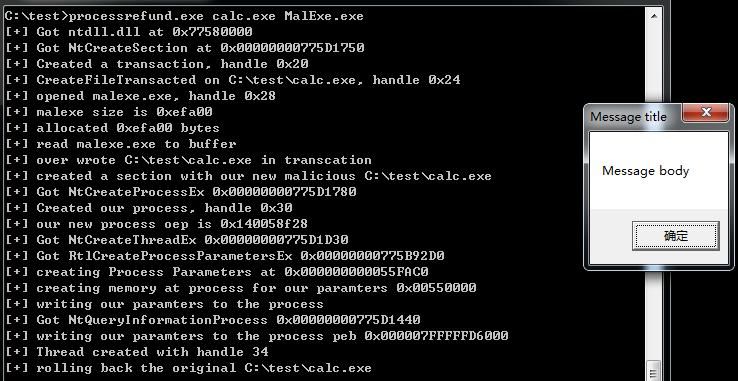
Actual test:
Win7 x64
Test as shown in the figure below
Note:
If calc.exe under system32 is selected, insufficient permissions will be prompted
Start process calc.exe, but actually execute MalExe.exe, pop-up dialog box
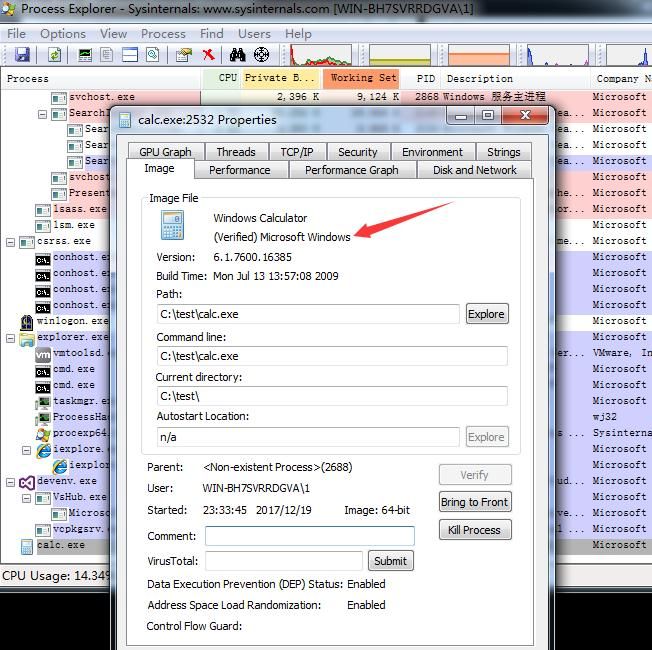
The icon and description of process calc.exe are both normal calc.exe, digital signature is also normal, as shown below
2. POC by hfiref0x
https://gist.github.com/hfiref0x/a9911a0b70b473281c9da5daea9a177f
Only one c file, missing header file ntos.h
Reference location:
https://github.com/hfiref0x/UACME/blob/master/Source/Shared/ntos.h
But secondary modifications are still required
To better understand the details, decided not to use the ntdll.lib file (included after installing DDK), and instead obtain Native API through ntdll (of course, the code volume will also increase)
Rewrite an ntos.h in my own way, and modify the original POC's inject.c
Open source address is as follows:
https://github.com/3gstudent/Inject-dll-by-Process-Doppelganging
Compilation tool: VS2012
Supports 32-bit Windows systems
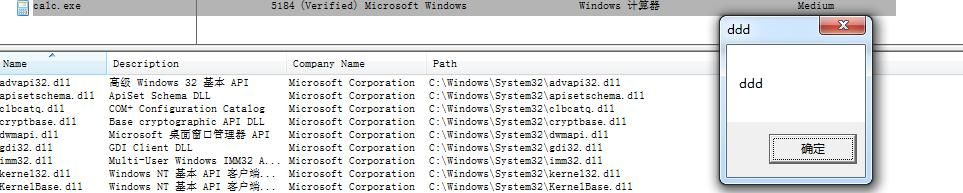
Actual testing:
Win7 x86
Test as shown in the figure below
Note:
If you choose calc.exe under system32, it will prompt insufficient permissions
In summary, we can see that Process Doppelgänging is similar to Process Hollowing in terms of exploitation effect: launching a normal process (normal icon, signature, description) and executing payload within this process
A disadvantage of Process Doppelgänging in exploitation: it requires file replacement, so when replacing files under system32, it will prompt insufficient permissions (administrator privileges cannot modify files in this path)
0x04 Exploitation Approach
---
In the previous section, we tested two POCs and gained some understanding of Process Doppelgänging.
In practical exploitation, further modifications to the POC are required. The exploitation approach is as follows:
Remove the functionality of reading the payload and replace it with storing the payload in a Buffer (which can be compressed and encoded to reduce its length).
During execution, read the Buffer, decrypt it, and execute it.
This further conceals the payload, achieving a "fileless" payload (the payload is stored in the exploit and does not need to be written to the hard disk).
0x05 Detection
---
Process Doppelgänging cannot bypass all antivirus software. Calls to several key functions (such as NtCreateThreadEx) can still be intercepted, and there are differences between the process memory and the PE file.
0x06 Summary
---
This article introduced the principles of Process Doppelgänging. Based on open-source code, a program was developed to achieve exploitation on Windows x86 and x64 systems, test its functionality, analyze the exploitation approach, and introduce detection methods.